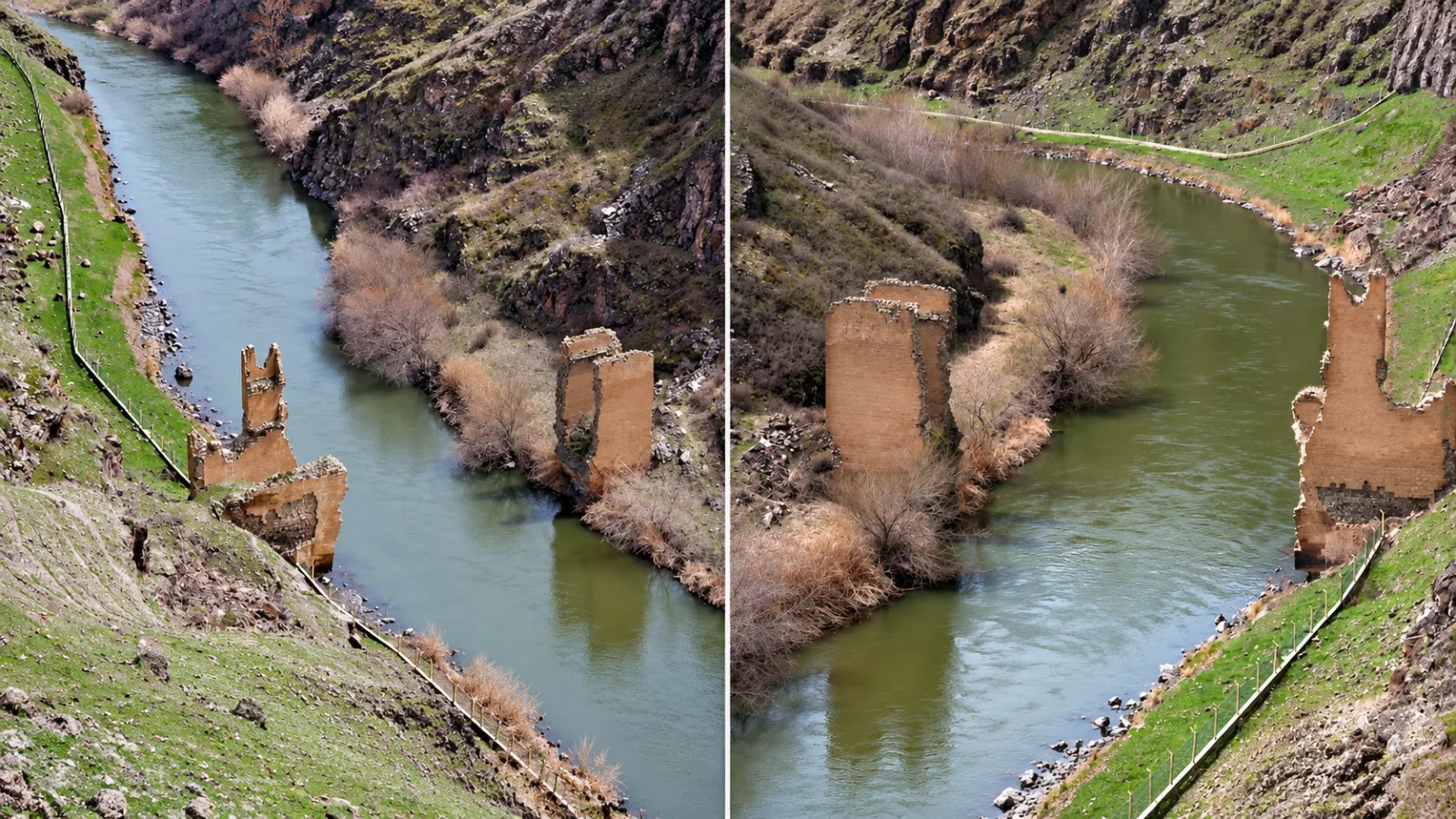
Preparations for raising the historic bridge located in the Ani archaeological site in Kars have moved to a new stage. Minister of Transport and Infrastructure Abdulkadir Uraloğlu announced that following the restoration implementation tender held by the General Directorate of Highways on September 16, 2026, the contract was signed on September 28.
The protocol defining the scope and method of the works was signed in Yerevan on May 4. The restoration process will be coordinated by a joint commission comprising representatives of Turkey and Armenia, with the Ministry of Transport and Infrastructure and the General Directorate of Highways among its members.
According to information shared by Uraloğlu, the original structure of the bridge, which served trade and customs crossings on the Silk Road route, was 80 meters long and 8 meters wide. It was stated that the arch with a span of 31 meters collapsed on October 16, 1807, and that only the pier remnants have survived to the present day.
Ani, one of the key centers of Armenian cultural heritage
Ani, where the bridge is located, served as the capital of the medieval Armenian Bagratid Kingdom and is one of the most important centers of Armenian history and architecture. According to UNESCO’s assessment, the city flourished in the 10th and 11th centuries, aided by its control of a branch of the Silk Road, and it maintained its importance on regional trade routes in subsequent periods. The Ani archaeological site was inscribed on the UNESCO World Heritage List in 2016.
Uraloğlu stated that the aim is to preserve the historic structure and pass it on to future generations by rebuilding the bridge. The statement did not share a timetable regarding the start and completion dates of the on-site works.